

One of our readers, Rose, asked: “What’s the big deal of Ham discovering Noah being naked?” Yes, what is the big deal? I’ve wondered that myself many times. Thankfully, a couple of years ago, the Holy Spirit showed me some things about that situation that may shed light on this peculiar part of Bible history recorded in Genesis 9.
Noah’s nakedness, and the actions of Ham, Shem, and Japhet, carry a deeper meaning than meets the eye. In fact, the full Biblical account of Noah and the flood is so prophetic that it deserves an article, or even a book, of its own. But to stay on topic, I will point out some symbols that will help us understand what truly happened when Ham saw Noah naked.
Trigger warning: Some readers may find some parts of this article distressing.
Who was Noah, really?
Noah was an ancestor of Christ (Luke 3:36), and he was righteous by faith (Hebrews 11:7; 2 Peter 2:5). The story of Noah, who saved mankind from destruction by obeying God, is an amazing part of history and a prophetic event that points to salvation through Christ. In this prophecy, Noah is a picture of Jesus, who brought His children (us) to safety through water (a symbol of Baptism and renewal; see 1 Peter 3:20-21). Perhaps a bit storm-tossed, but safe (Isaiah 54:11). Safe from the destruction that will happen to those who aren’t taken before the earth is destroyed (Matthew 24:36-41).
The name Noah is correctly pronounced as Noach (with a throaty “ch” as in Bach) and means “rest,” which I believe refers to the rest we have through Christ Jesus: The rest we can experience now and in the future when, by faith, we hold on to His grace and stop working for salvation (Matthew 11:28-29; Hebrews 3:7-10, 4:1-11; Revelation 14:13).
When Noah set foot on the earth after the flood had ended, God blessed him and his sons in the same way He blessed Adam and Eve. This is how He blessed Adam and Eve: “And God said to them, ‘Be fruitful and multiply and fill the earth and subdue it, and have dominion over the fish of the sea and over the birds of the heavens and over every living thing that moves on the earth.’” (Genesis 1:28, ESV)
And this is what He told Noah and his sons: “Be fruitful and multiply and fill the earth. The fear of you and the dread of you shall be upon every beast of the earth and upon every bird of the heavens, upon everything that creeps on the ground and all the fish of the sea. Into your hand they are delivered.” (Genesis 9:1-2, ESV)
In both blessings, God gave them authority over all flesh, just as Jesus gives us authority over the flesh in Him. We have this authority in Christ because Jesus has been given all authority in heaven and on earth by God the Father, who is sovereign (Matthew 28:18).
But there was also a big difference: Adam and Eve were consequently commanded to be vegan, eating only plants and fruits, while Noah and his offspring were allowed to add meat to their diet (Genesis 1:29, 9:3-4). Not just the meat that was considered clean, but the meat of “every moving thing” without its blood!
This is deeply symbolic, and you will understand why when you compare this text to Peter’s vision about killing and eating even unclean animals in Acts 10. After Peter received his vision, the Holy Spirit told him to go with the Gentiles He had sent without hesitation (Acts 10:19). Peter later explained that his vision meant that God shows no partiality: God accepts all who accept His Word (Acts 10:28-48; 11:1-18).
People of all nations are invited to the banquet. Our Great Commission is to multiply by making disciples of all nations, baptizing them in the name of the Father and of the Son and of the Holy Spirit, teaching them to observe all that Jesus has commanded us (Matthew 28:19-20). That is what God’s command to Noah foreshadowed.
[The text continues after the image.]
Why did Noah become drunk?
It is no coincidence that Noah became “a man of the soil” (Genesis 9:20). Throughout the Bible, vineyards, fields, and gardens, are symbols of the places in which we are commanded to labor, sow the Word, and produce fruit in Jesus’ name (Isaiah 5:1-7; Matthew 13:38, 20:1). And drinking their wine, or eating their fruit, is part of the blessing we receive for our labor (Amos 9:14; 1 Corinthians 9:7). So, this fits into the prophetic picture perfectly.
But I always found it striking that Noah became drunk; it seems so sinful for a man who was held to a high standard of righteousness throughout the Scriptures. That changed when I understood that this, too, was symbolic.
There are two spiritual meanings to drunkenness that may seem unrelated at first, but are actually two sides of the same coin.
Drunk with God’s love
Various Scripture verses point to a drunkenness on God’s love as an overflow of the Holy Spirit. We see this symbol in Song of Solomon 5:1, where unity with Christ in every way leads to being drunk with love. Being overcome by God is also compared to drunkenness (Ephesians 5:18; Acts 2:15; Jeremiah 23:9). That makes sense because, after all, wine (or grape juice) is a symbol of the blood of Christ (John 6:54-56).
But since wine is a symbol of blood, there is also another side to the symbolism:
Drunk with the blood of God’s enemies
God’s consuming fire refines by destroying sin in those who are declared holy, but that same fire destroys the sinful completely. This wrath, coming from God’s righteousness, is the other side of the coin. In the Bible, this is sometimes symbolized as becoming drunk with the blood of God’s enemies.
The following text in Ezekiel is a good example, and on top of that, it directly relates to Noah’s situation:
“As for you, son of man, thus says the Lord God: Speak to the birds of every sort and to all beasts of the field: ‘Assemble and come, gather from all around to the sacrificial feast that I am preparing for you, a great sacrificial feast on the mountains of Israel, and you shall eat flesh and drink blood. You shall eat the flesh of the mighty, and drink the blood of the princes of the earth—of rams, of lambs, and of he-goats, of bulls, all of them fat beasts of Bashan. And you shall eat fat till you are filled, and drink blood till you are drunk, at the sacrificial feast that I am preparing for you. And you shall be filled at my table with horses and charioteers, with mighty men and all kinds of warriors,’ declares the Lord God” (Ezekiel 39:17-20, ESV).
This text contains the same symbolism as that in the story of Noah we just discussed. Needless to say, this was never about humans drinking actual blood, since that has always been strictly forbidden by God. No, this is about God’s wrath. When God dealt with the horrendously evil people on earth, they died in the flood.
Today’s evil is rapidly going in the same direction as that of the days of Noah. And we know that those who won’t repent and accept Jesus as Lord and Savior will succumb to the wrath of the very God they despised. We can read in Revelation what that looks like:
“And another angel came out from the altar, the angel who has authority over the fire, and he called with a loud voice to the one who had the sharp sickle, ‘Put in your sickle and gather the clusters from the vine of the earth, for its grapes are ripe.’ So the angel swung his sickle across the earth and gathered the grape harvest of the earth and threw it into the great winepress of the wrath of God. And the winepress was trodden outside the city, and blood flowed from the winepress, as high as a horse’s bridle, for 1,600 stadia” (Revelation 14:18-20, ESV).
The Person doing the treading is Jesus: “From his mouth comes a sharp sword with which to strike down the nations, and he will rule them with a rod of iron. He will tread the winepress of the fury of the wrath of God the Almighty. On his robe and on his thigh he has a name written, King of kings and Lord of lords” (Revelation 19:15-16, ESV).
You can read another descriptive reference in Isaiah 63:2-6.
Because of these verses, I believe that Noah was symbolically portraying God’s wrath: the wrath that had just taken place, and the future wrath in the End Times. Jesus said that when He comes back, it will be just like the days of Noah (Matthew 24:37). Let’s make sure that we are “on the ark” with our Savior when that time comes!
[The text continues after the image.]
What does nakedness mean in the Bible?
The Bible teaches that, since the fall, public nakedness was considered shameful and/or sinful; that is why it was often used as a symbol of sin and shame. Being naked means being exposed and unprotected. Without proper outerwear, we are vulnerable. And if there is sin, it is right out there in the open for all to see.
Sometimes prophets would even prophesy naked to demonstrate the sin and shame of a proud people who put their hope in the wrong things (Isaiah 20; Micah 1:8).
To God, we are all naked: “And no creature is hidden from his sight, but all are naked and exposed to the eyes of him to whom we must give account” (Hebrews 4:13, ESV). People, in contrast, can be fooled by appearances. For example, someone dressed like a priest doesn’t have to be a holy person.
Drunk and uncovered
Drunkenness and nakedness are mentioned together in the Bible more than once. I believe because alcohol dulls our inhibitions and discernment. When we use too much of it, sin that is buried deep inside of us can come out, and we can be led astray (Proverbs 20:1, 23:29-35; Isaiah 28:7; Hosea 4:11; Lamentations 4:21-22).
In a way, all worldly people are drunk and naked. They are in a drunken stupor, exposing their sin to the world (Revelation 17:2; 1 Corinthians 15:34; Nahum 1:10; Jeremiah 51:7). They drown their sorrows and the emptiness they experience with even more sinful actions, leading to an even deeper stupor.
The cure for this drunken, naked stupor is waking up, realizing your nakedness, and being clothed with the holy garments given by Christ. In other words: to repent, to be baptized, and to walk in the righteousness of Christ, forgiven and covered by His blood.
The symbol of Adam and Eve’s nakedness
Did you realize that God already modeled this with Adam and Eve? When they realized they were naked and felt ashamed, they made loincloths for themselves, made of fig leaves (Genesis 3:7). But it didn’t work, because as soon as they became aware of the presence of God, they hid themselves, still ashamed of their nakedness and afraid of God’s punishment (Genesis 3:8-10). This represents the unsuccessful works we do in our own strength to cover up our sin and shame. We need God’s grace to be saved; our works cannot do away with our sin and make peace with God (Ephesians 2:8).
Later, God made them garments of skin, which meant He made the first animal sacrifice to cover sin (Genesis 3:21). Thankfully, 2000 years ago, Jesus sacrificed Himself once and for all, so that we could be covered once and for all.
Naked and vulnerable
In the New Testament, we can read of two occasions where nakedness revealed weakness and faithlessness: the follower of Jesus who fled naked when Jesus was arrested (Mark 14:52) and the exorcists who were overpowered by the demonized man (Acts 19:16). These examples show that without Jesus we are vulnerable, sinful, and shameful beings.
Glorious nakedness
But not all nakedness is sinful, of course. For example, nakedness can be something glorious when shared among spouses, as we can read in the Song of Songs. The husband’s nakedness is meant for his wife and the wife’s nakedness for her husband, for they are as one (Leviticus 18:7, 20:11; Deuteronomy 27:20).
God gave various commands to shield His people from being seen naked by unauthorized people, including unauthorized family members (Exodus 28:42, 20:26; Leviticus 18:6-19, 20:17-21). So, being naked was and is also seen as something precious, something to be protected, something to be preserved for the love of your life.
I know that this can be hard to read for some, and perhaps even triggering for those of us whose nakedness was not preserved for their spouses. For those who, even with their loving spouse, continue to associate nakedness with sin, pain, helplessness, danger, and shame. I can deeply relate to that. But I have also learned that this is a perspective built from trauma, not from the reality God wants us to see.
God is not appalled by our nakedness; He doesn’t judge our nakedness as we do. Even though some of the consequences of our past life may still be present, He is not angry with us, His children. He created us, and He loves us, and sees us just like a parent who looks at their newborn with a heart overflowing with love. He has washed us clean and covered us, and now offers comfort, care, protection, and growth. He doesn’t run away from us; He embraces us. So, let’s not run away from Him in shame, but towards Him in faith!
The hidden meaning of Noah’s nakedness
Meet Ham, Noah’s youngest son (Genesis 9:24). His name (correctly pronounced as Cham) means “hot,” which can also refer to a hot temper. Ham’s actions would cost him and many generations after him. Let’s talk about why.
There’s nothing weird about someone lying naked in the privacy of their own tent, so there must have been more to the story.
I don’t know whether Ham entered his father’s tent without permission (which would fit the picture) or whether the curtain was slightly open so that he could see his father naked through the gap. Either way, Scripture says that Noah lay uncovered “in the midst” of his tent. The Hebrew word used (בְּת֥וֹךְ) is the same word used to describe that the tree of life was in the middle of the Garden (Genesis 2:9, 3:3). It’s also the same word used in these sentence structures “the ark of God dwells within [בְּת֥וֹךְ] tent curtains” (2 Samuel 7:2b) and “And they brought the ark of Yahweh and set it in its place in the midst [בְּת֣וֹךְ] of the tabernacle” (2 Samuel 6:17a).
Therefore, I wonder if Noah’s nakedness could be a picture of seeing all of God (Psalm 26:8, 27:4). The “nakedness” of human beings symbolizes seeing all of that person, including their sin, but because there’s no sin in God, seeing all of God would only expose all of His holiness and glory. But God is a fire that consumes all sin, so no sinner can see the fullness of God and live (Exodus 24:17, 33:20; Deuteronomy 9:3; Hebrews 12:29). Therefore, He veils (covers) it for their protection until they are purified (Leviticus 16:2-4; 2 Corinthians 3:13-16; Hebrews 10:19-22).
God is also Spirit, and therefore, we cannot see Him with our physical eyes (John 1:18, 4:24). So He shows Himself through, for example, His Word, and people created in His image (Hebrews 1:3). That is one reason God came to earth in tents: first in the tabernacle and the temple, then in the flesh as Jesus, then in the Body of believers (John 14:9; Acts 15:16; Ephesians 2:22; Colossians 1:15).
But one day, we will be able to fully see Him, know Him, and be with Him (1 Corinthians 13:12; Revelation 22:4-5). Because just as nakedness is supposed to be preserved for spouses, truly seeing God as He is, is only permitted for Christ’s holy, clean Bride (Leviticus 21:23; Matthew 5:8; 1 John 3:2; 2 Corinthians 3:18).
In Noah’s story, Ham looked at his father’s nakedness, which was sinful in itself. Then, instead of doing something about it and showing some respect, Ham walked away and gossiped. This is why I believe what Ham did is such a big deal: through his sin, he became a picture of being disrespectful towards our Father and putting Him to shame.
Because of his actions, Noah cursed Canaan, Ham’s son, to slavery to his other offspring. This is an important piece of history because the people of the land of Canaan (named after its founder) were eventually either destroyed or enslaved by the Israelites in the battle for the Promised Land (Numbers 13:2, 21:3; Deuteronomy 20:17; Leviticus 25:38; Joshua 16:10, 17:13; Judges 1:27-30). Even today, we see the consequences in the Gaza region, to which the territory of the Canaanites extended (Genesis 10:19).
[The text continues after the image.]
The righteousness of Shem and Japhet
Ham’s older brothers were Shem (meaning “Name”) and Japhet (meaning “enlargement” as in “wide spreading” or “expanding”). Their names are, as usual, prophetic: Shem would be a forefather of Jesus (Luke 3:36), who carries the Name above all names.
Noah blessed Japhet according to his name when he said, “May God enlarge Japheth, and let him dwell in the tents of Shem, and let Canaan be his servant,” (Genesis 9:27, emphasis added).
However, these words of blessing have meaning beyond the fact that they became a large, widespread people. See, Noah said that Japhet would dwell in the tents of Shem. When we put our spiritual glasses on, this seems to refer to a people who would dwell in the tent of the Almighty, the house of God: us.
As Christians, we are fruitful and we multiply because the Holy Spirit dwells in our tent (1 Corinthians 3:16; Romans 8:11; John 14:17). But after a little while, we will dwell victoriously in the house of the Lord, until God makes all things new and He will dwell with us, perhaps as He did before the fall (Psalm 27:4; 2 Corinthians 5:1-8; Revelation 21:1-3).
Shem and Japhet didn’t follow Ham in his sinful ways. They could have responded in a variety of ways. They could have laughed at their father, been filled with shame, or ignored the situation. But they chose the right course of action: they didn’t sinfully look upon their father’s nakedness, but respectfully covered him. Covering the naked (literally and spiritually) is righteous in God’s eyes (Ezekiel 18:7; Isaiah 58:7).
What does it mean to cover nakedness?
As we’ve discussed, nakedness is not for all to see. Whether spiritual or physical, it needs to be covered. What Shem and Japhet did is therefore symbolic of what God expects of us. God wants us to walk in His image, and He covered our sins by His blood. He made us right with Him when He covered our nakedness through Christ (Ezekiel 16:8; Psalm 85:2; Isaiah 61:10; Romans 4:7).
He wants us to treat one another in the same way. When we see the sin and shame of others, what do we do? Do we discuss it with other people, or do we respectfully cover it and protect their dignity?
It’s often easier to see the sin of a brother or sister than our own. When a family member in Christ isn’t aware of their sin, we should not just turn to our brothers and sisters and gossip; we should do something about it: “whoever brings back a sinner from his wandering will save his soul from death and will cover a multitude of sins” (James 5:20b).
How much more should we cover a person in authority? A parent, a ruler of a country, a husband, a pastor? Sometimes we see their sin and gossip about it instead of taking action to cover them.
So how would we take action? Shem and Japhet already modeled this for us by their actions: “Then Shem and Japheth took a garment, laid it on both their shoulders, and walked backward and covered the nakedness of their father. Their faces were turned backward, and they did not see their father’s nakedness” (Genesis 9:23). Let’s see what we can learn from the steps they followed:
- “Then Shem and Japhet took a garment.” This tells us that they worked together. Together, they decided they would take a garment to cover their father. Then they would have discussed their approach. Two people walking backward with a garment takes coordination. They needed to move as one, at the same pace.
As Christians, we should work together in unity to help each other reach the finish line, too. We need to discuss our approach and walk in step with each other to achieve our goals. Before we can do this successfully, though, we must walk in step with the Holy Spirit. If each of us walks in step with Him, we will all walk in the will of God in unity. - The “garment” would have been a cloak or robe, made of wool, linen, or animal hide. You can read about the symbolic meaning of wool and linen in another article, but either way, the covering is symbolic of the covering of sin through the sacrifice of the Lamb of God. And therefore of being clothed by His righteousness and holiness, instead of the shame of nakedness.
His cover also serves to protect us. It protects our dignity and makes us less vulnerable to outside influences (you can read the series The Full Armor of God for a better understanding of this principle). - “Laid it on both their shoulders.” This part of the sentence is left out in some translations, but I think it’s relevant; otherwise, the Holy Spirit wouldn’t have mentioned it.
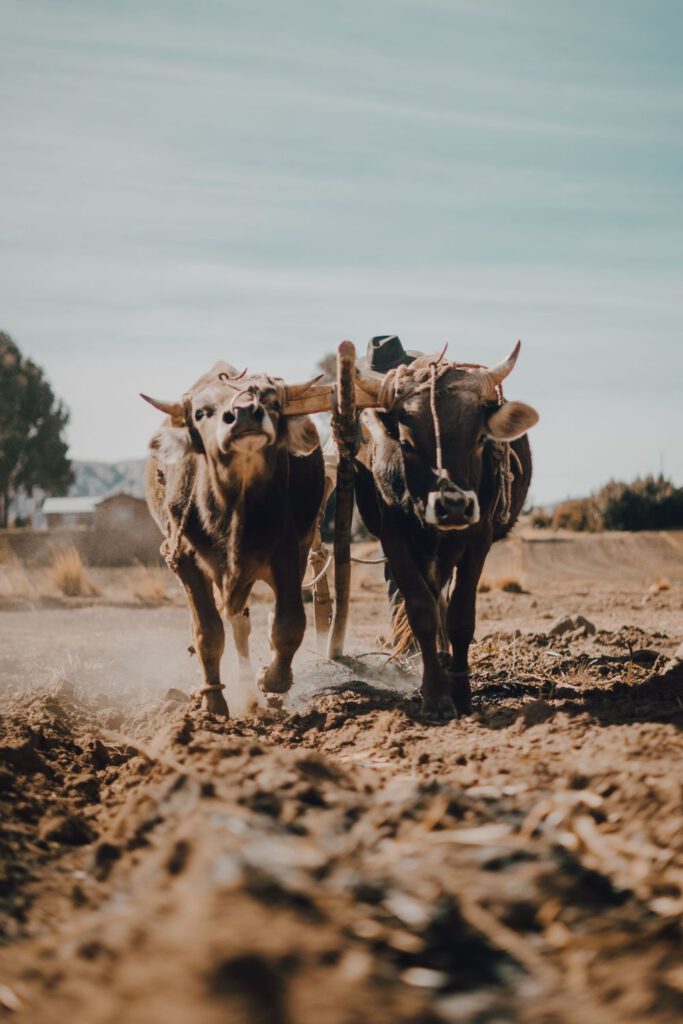
Robes were made of long cloth that was tied together with a belt, so they had to hold the garment high to avoid tripping over it. I always imagined that one brother carried one side on his left shoulder and the other brother the other side on his right shoulder. But technically, they both could have carried it on both shoulders, like oxen carrying a yoke (see the image below). This is a wonderful picture of two like-minded people serving God together.
When Jesus said that His yoke was light, He implied it wouldn’t be a yoke of works done on our own strength, but that we would labor together with Him (Matthew 11:28-30). And when Paul said that we shouldn’t be yoked to unbelievers, he meant they would become a burden for we wouldn’t even walk in the same direction (2 Corinthians 6:14). Shem and Japhet were of one mind and carried the burden together, even though the garment had to be very light for two strong men. We, as Christians, should always cooperate with Jesus and walk by His side to ensure our yoke is light too. - “And walked backward.” Why didn’t they just close their eyes and walk forward? Some years ago, at a trauma center for PTSD, a few women and I were asked to do an exercise: walking towards a goal blindfolded. I don’t remember what the purpose of that exercise was exactly, but I vividly remember that nobody could do it, even after multiple attempts. Everyone strayed either to the right or to the left. So, I believe that Shem and Japhet walked backwards for their orientation, to know where they were going, without peeking. Because as Christians, we are not blind nor blindfolded; we know where we are going. Even when we don’t exactly see where we are or when we will reach our destination, we keep our eyes wide open so that we won’t stray to the left or the right. The fact that they walked backward and still made it illustrates that we don’t have to walk by sight; we walk by faith (2 Corinthians 5:7). Each step we take is by faith that we will reach our destination: our glorious Father in heaven.
- “And covered the nakedness of their father.” They covered him with the garment. I believe we follow this example by extending the mercy, grace, forgiveness, and holiness of Christ to others who need it. We put God’s love into action. For example, we help, protect, forgive, pray, bless, and educate to save our brothers and sisters from sin and its consequences: “Above all, keep loving one another earnestly, since love covers a multitude of sins” (1 Peter 4:8).
- “Their faces were turned backward, and they did not see their father’s nakedness.” They made sure they didn’t see what they weren’t supposed to see. And for that, they needed self-control. Even if they had felt tempted to look, they clearly had withstood the temptation. As soon as he was covered, there wouldn’t be any nakedness left to see.
This is precisely what God does when he covers all our sins. He forgives us and doesn’t look at our sin anymore, even though He knows that underneath His cover, we are naked. All He looks at is the likeness of His Son, since we are covered by His precious blood. As long as we are covered, He no longer feels wrath and anger towards us (Psalm 85:2-3, 103:1-14). - In all their actions, they took their father seriously and remained humble, unlike Ham. From love and reverence for the Father, righteous deeds flow. Because of this, they received honor and blessings as a reward that would last for generations, just as we will receive an eternal reward for our faith and the fruit that we produce by it. For God exalts those who humble themselves before Him (Matthew 23:12; 1 Peter 5:6; James 4:10).
Let’s close by reading Matthew 25:34-46 (ESV):
“Then the King will say to those on his right, ‘Come, you who are blessed by my Father, inherit the kingdom prepared for you from the foundation of the world. For I was hungry and you gave me food, I was thirsty and you gave me drink, I was a stranger and you welcomed me, I was naked and you clothed me, I was sick and you visited me, I was in prison and you came to me.’ Then the righteous will answer him, saying, ‘Lord, when did we see you hungry and feed you, or thirsty and give you drink? And when did we see you a stranger and welcome you, or naked and clothe you? And when did we see you sick or in prison and visit you?’ And the King will answer them, ‘Truly, I say to you, as you did it to one of the least of these my brothers, you did it to me.’
Then he will say to those on his left, ‘Depart from me, you cursed, into the eternal fire prepared for the devil and his angels. For I was hungry and you gave me no food, I was thirsty and you gave me no drink, I was a stranger and you did not welcome me, naked and you did not clothe me, sick and in prison and you did not visit me.’ Then they also will answer, saying, ‘Lord, when did we see you hungry or thirsty or a stranger or naked or sick or in prison, and did not minister to you?’ Then he will answer them, saying, ‘Truly, I say to you, as you did not do it to one of the least of these, you did not do it to me.’ And these will go away into eternal punishment, but the righteous into eternal life.”
You may also like: